The Inclusional Harmonies of the World
Pender Island, February 12, 2003
www.goodshare.org/johannes.htm
Johannes carefully adjusted the relative positioning of the
ecliptic and celestial equator on the giant brass armillary to give the current
approximate sky-coordinates of Mars, writing them neatly into his journal though his mind
was elsewhere. The short walk in the cold night air, from Uraniborg,
Tycho’s older observatory, through the perimeter wall to ‘Stjerneborg’,
the new ‘star castle’ observatory, refreshed the resonant acuteness of his
thoughts.
Once installed in the largest of Stjerneborg’s subterranean observing amphitheaters with its openable dome, he flipped through his journal till he came to the last entry he had made in the long list of coordinate entries for Mars. A list that he had begun in 1580 and which he had been continually extending, culminating with this latest and final update in the winter of 1597.
Johannes thoughts were interrupted by the sound of
footsteps in the connecting chamber. He hesitated before looking up from
his work and when he looked over, in the softness of the candlelight he could
just make out the youthful female form of Magdalene, who, having followed him
and after quickly casting off her clothes, was climbing into the large and
comfortable visitors bed that Tycho had provided for guests to the observatory.
Magdalene’s silent attendance was a powerful attractor for Johannes and as he
adjusted his instrument he believed he could sense the warm fragrance of her
skin even from this great a distance. Faintly, he could hear the
half-whimpers of her longings resonating in the cupola’d bed-chamber, …
half-whimpers that coupled with the rustlings of bed clothes to induce seductive
imagery of the re-arranging of her beautiful limbs, a
soft semaphore of love’s beckoning.
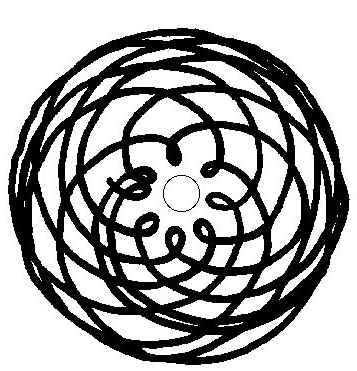
But Johanne’s work came first and he peered out through the instrument into the deep blue-black of space starkly lit by the bright light from the Earth’s neighbouring planet Mars, a brilliant whiteness whose reddish tinge emerged in full force when viewed through Tycho's instruments. He opened his journal to where he had been graphing the coordinates of Mars over his past seventeen years of observation, and reflected on the pretzel-shape of Mars' orbit about the Earth;.
But, of course, it was Copernicus who had first suggested that such a motion for Mars might be suggesting 'something else'. A motion in which Mars, in approaching the Earth most closely, reversed its direction and came in for a closer look, as a passing bee attracted by some sweet scent might do, and after just passing it, turning back on a reconnaissance loop only to lose interest and complete the loop to resume its original course. Nine times had Mars performed this pretzel-loop on its closest approach to the Earth in the past seventeen years. Johannes knew that the pretzel loops were explained away when this 'something else' of Copernicus was invoked in the mind, ... a new image of the planetary dynamics in which the Earth was no longer the center of the Universe but where both the Earth and Mars and the other planets were moving relative to some other center of coordination, namely the Sun.
But there was nothing 'false' about this pretzel-shaped orbit, it was the real and actual dynamical experience of the Earth, and Earth-observer relative to Mars. The difference was that it was not the movement of Mars-in-its-own-right that the Earth-astronomer was looking out at, but the relative movement of the Earth and Mars as they both danced together and with their solar system family to the 'harmony of the spheres'.
Johannes noticed that Magdalene's subtle beckoning for him to come and join her had ceased and he now heard, in low whispers, the deep resonant voice of Søren, Tycho's stable boy, a simple but strikingly handsome youth who himself had the strength of horses. Søren was a favorite of Tycho's and was allowed free passage through the gardens and buildings of Uraniborg and Stjerneborg. Magdalene's child-self always came to the fore when she saw Søren and the two would laugh and play in a carefree manner like mother and child on a Sunday outing. Johannes felt relieved by Magdalene's distraction, collapsing as it did, the desires that had been mounting in him as they rose in her, distracting him from the deep thoughts that were coming to him from his Mars observations.
Johannes returned his thoughts to his journal and the notes he had made for his forthcoming publication "Harmonies of the World". He was not happy with his first two laws of motion in that they were expressed in the flat plane while his experiencing of the celestial harmonies was in the domain of volume, of inner-outer relationships. While Copernicus had suggested that the Earth and planets revolved around the Sun in circular orbits, this could not be supported by the precision measurements of Tycho, which suggested instead, elliptical orbits with the sun occupying one of the two foci of the ellipse.
He glanced at his diagram of the second law of motion, showing how the orbital radius swept out equal areas in equal time, compensating for the greater relative speed of the planet when the orbital radius penetrated deeper into space than when its penetration was shallow, unlike the uniformity of the length of orbital radius and shape of the areas swept in time, in the case of circular orbits, as he had drawn as an inset over the ellipse to remind him of this intrinsic difference.
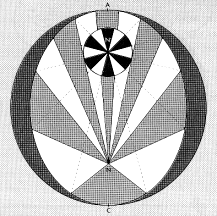
As he thought of this non-uniform cyclicity as it transpired in the spherical volume of space, he thought of the inner-outer 'oooh - aaah' action of the inhalation and exhalation of air from and into the lungs and blood from and into the heart, and his mind inquired yet again into the meaning of the unoccupied focus of the ellipse and its 'virtual' influence on the cyclicity. He pages through his notes and came to the paragraph;
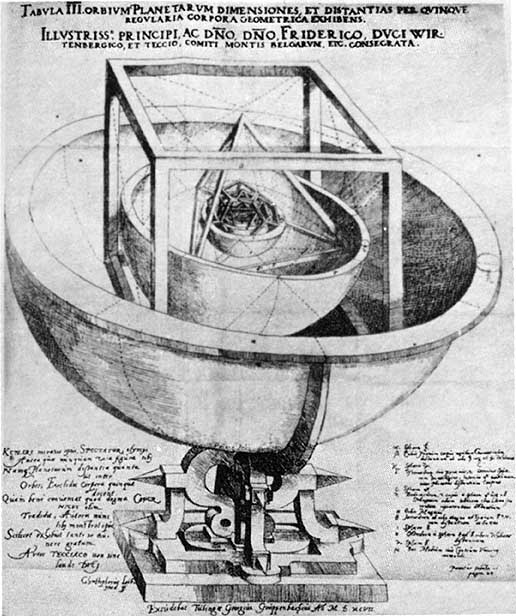
"Pythagorus had said that the earth is made from the cube, the fire from the pyramid, air from the octahedron, water from the icosahedron, and the sphere of the whole - the Aither - is made from the dodecahedron. He had said that Thales and those who followed him stated that there was one earth, but that he knew there to be two - our own and the counter-earth - which most folk knew to be the moon, but that the location of the element fire was at the very center and that it was about this central cosmic fire - the hearth of the cosmos - that both earth's turned. More than 2000 years ago, Pythagoreans said that these five [regular solids] were the figures of the world as they believed that the four elements and the heavens --- the fifth essence --- were conformed to the archetype for these five figures. But the truer reason for these figures including one another mutually is in order that these five figures may conform to the intervals of the spheres. Therefore, if there are five spherical intervals, it is necessary that there be six spheres: just as with four linear intervals, there must necessarily be five digits.[1]"
While the sun seemed to recapture the errant planets each time they made their break towards the free expanses of the enveloping and including sphere of space, what was it in space itself that induced the planets to accelerate out of the capture of the curve into the openness of space?
Johannes continued to read the notes he had prepared for his writing of 'Harmonies of the World' that sought to address this inner-outer gender-dynamic;
"Behold, as the generations of animals in this terrestrial globe have an image of the male in the dodecahedron, of the female in the icosahedron ---- whereof the dodecahedron rests on the terrestrial sphere from the outside and the icosahedron from the inside: what will we suppose the remaining globes to have from the remaining figures?" [2]
He turned once again to his tables giving the ratio-ing of the planetary ellipses relative to a space-sphere of semi-diameter 100,000, and their relationship to the regular solids;
Planet . . . . . . . . . . . . Orbital Radius. . . . . . . . Regular Solid
Saturn . . . . . . . . . . . . 10,052 - 8,968. . . . .
. . .Cube
Jupiter. . . . . . . . . . . . . 5,451 - 4,949. . . . . . . . Tetrahedron
Mars. . . . . . . . . . . . . . .1,665 - 1,382. . . . . . . . Dodecahedron
Earth. . . . . . . . . . . . . . . .1,018 - 982. . . . . . . . .Icosahedron
Venus. . . . . . . . . . . . . . . . 729 - 719. . . . . . . . .Octahedron
Mercury. . . . . . . . . . . . . . .470 - 307. . . . . . . . .Square within
Octahedron [1]
And he reflected once more on how the mutually-including solids, as he had written in his notes; "imitate the sphere --- which is an image of God --- as much as a rectilinear figure possibly can, arranging all their angles in the same sphere. And they can all be inscribed in a sphere. And as the sphere is everywhere similar to itself, so in this case the planes of any one figure are all similar to one another and can be inscribed in the same circle; and the angles are equal.[1]
There was no way that the geometry of flat planes and absolute distances could capture the inner-outerness of the planetary dynamics, nor did the simple 'cyclicity' or 'frequency' of the orbiting in the back-and-forth sense given by the action of the orbital radius rotating on a flat plane give this innate sense of inner-outerness, ... the deepening and shallowing penetration of space, ... the 'ooohing and aaaahing' cyclicity that recalled the filling-and-emptying of air in the lung, and blood in the heart.
Just as the mesmerizing dance of Mars around the earth distracted him from the simultaneous and mutually influencing behaviours of the other planets going on all around him, and including him and his observation post in their dynamics, ... he realized it was so for all things in life. To focus on one thing and to detail and describe it in the absolute and sequential terms of ratio-cination was to lose track of what was simultaneously emerging, in the enveloping and including dynamics of space. He flipped over several pages in his journal to regain his most recent notes that sought to deal with the deeper inner-outer harmony, the resonance of the spheres of space, that seemed to be induced by the enveloping and including outer-inner dynamical potentials of space itself;
"while the harmony does not adorn the termini; i.e. the single movements, in so far as by being taken together and compared to one another, they become the object of some mind;" ... "that in the farthest movement of any two planets, the universe was stamped with the adornment of harmonic proportions; and, accordingly, in order that this adornment might be brought into concord with with the movements, the eccentricities which fell to the lot of each planet had to brought into concord." ... "Now, the 'harmony-of-the-whole of all the planets contributes more to the perfection of the world than the single harmonies by twos and the pairs of harmonies by the twos of neighbouring planets. For harmony is, so to speak, a volumeful of unity. A deeper unity yet is presented, when all the planets form a harmony with each another, as when just two at a time harmonize in a bivalent manner. In the interference of these harmonies deriving from the dual harmonic line-ups, which the pairs of planets form with each another, the one or the other must give way (yield), so that the harmony-of-the- whole can prevail."[2]
In order to make sense out of the measurements, which clearly implied a harmony not just within the planetary orbitals themselves but between and amongst the orbitals, he had realized that the pseudo-absoluteness of the ratio-cinative measures had to be relaxed in order to conceive of this simultaneous inclusional harmony and he made sure that his notes were clear in reflecting this necessity;
"But whose good will it be to have harmonies between the journeys, or who will perceive the harmonies? For there are two things which disclose to us harmonies in natural things either light or sound light apprehended through the eyes or hidden senses proportioned to the eyes, and sound through the ears. The mind seizes upon these forms and, whether by instinct (on which Book IV speaks profusely) or by astronomical or harmonic ratiocination, discerns the concordant from the discordant. Now there are no sounds in the heavens, nor is the movement so turbulent that any noise is made by the rubbing against the ether. Light remains. If light has to teach these things about the planetary journeys, it will teach either the eyes or a sensorium analogous to the eyes and situated in definite place; and it seems that sense-perception must be present there in order that light of itself may immediately teach. Therefore there will be sense-perception in the total world, namely in order that the movements of all the planets may be presented to sense-perceptions at the same time. For that former route --- from observations through the longest detours of geometry and arithmetic, through the ratios of spheres and the other things which must be learned first, down to the journeys which have been exhibited --- is too long for any natural instinct, for the sake of moving which it seems reasonable that the harmonies have been introduced. Therefore with everything reduced to one view, I concluded rightly that the true journeys of the planets through the ether should be dismissed, and that we should turn our eyes to the apparent diurnal arcs, according as they are all apparent, from one definite and marked place in the world --- namely, from the solar body itself, the source of movement of all the planets and we must see, not how far away from the sun any one of the planets is, nor how much space it traverses in one day (for that is something for ratiocination and astronomy, not for instinct), but how great an angle the diurnal movement of each planet subtends in the solar body, or how great an arc it seems to traverse in one common circle described around the sun, such as the ecliptic, in order that these appearances, which were conveyed to the solar body by virtue of light, may be able to flow, together with the light, in a straight line into creatures, which are partakers of this instinct, as in Book IV we said the figure of the heavens flowed into the foetus by virtue of the rays."[2]
It was clear to Johannes that every time we focused ratiocinatively on an aspect of the world, it took our mind out of the continuing dynamic of the present that enveloped and included us and that our own actions relative to others were co-creatively helping to shape and evolve. For our ratiocinations were dependent upon time and sequence, how things acted along a time-line from the past into the future. Meanwhile, as had come into confluence in his mind from the multitudinous observations of the planets, the deeper harmonic aspect could not even be visualized in sequential terms, but instead emerged from the simultaneous co-evolution or 'communal becoming' of the collective dynamic;
“Furthermore, a great distinction exists between the consonances of the single planets which have been unfolded and the consonants of the planets in pairs. For the former cannot exist at the same moment of time, while the latter absolutely can; ..” … “As the essence of movement consists not in being but in becoming, so too the form or figure of the region which any planet traverses in its movement does not become solid immediately from the start, but in the succession of time acquires at last not only length but also breadth and depth (its perfect ternary of dimensions); and, gradually, thus, by the interweaving and piling up of many circuits, the form of a concave sphere comes to be represented --- just as out of the silk-worm’s thread, by the interweaving and heaping together of many circles, the cocoon is built.”[2]
Johannes realized the the ancient wisdom was re-emergent in these findings, ... findings that unequivocally demonstrated that focused ratiocinations, no matter how detailed and extensive, will never fully inform us of a dynamic that envelopes and includes us, and the more we focus and measure in abstract, absolute detail what we see 'out there', the more we shall fall out of intuitive touch with our own co-creative participation within the including dynamic. In his notes, he had recorded that our manner of understanding the enveloping-including dynamics of the community of sun and planets, was a geometro-dynamical archetype for our manner of understanding the world around us;
"But if it is permissible, using the thread of an analogy as a guide, to traverse the labyrinths of the mysteries of nature, not ineptly, I think, will someone have argued as follows: The relation of the six spheres to their common centre, thereby the centre of the whole world, is also the same as that of diagoia [discussive intellection] to hous [intuitive intellection], according as these faculties are distinguished by Aristotle, Plato, Proclus, and the rest; ..."[2]
With the quiet intensity of deliberation that characterized his entire history of astronomical explorations, he descended back into the bottom of the amphitheater, checked and adjusted his instrument. The moon was shining brilliantly through the clear cold skies of the Danish winter, yet he felt bathed in a warmth emanating from a passionate presence in the space around him. He checked the coordinates of Mars yet again on the armillary and adjusted his instrument. The celestial view inspired him beyond all measures, and he imagined he could hear the inner-outerness of the celestial dynamics, ... the cyclic oooohhhs and aaaahhhs that recalled the aspirant sighs of Magdalene in the full fever of love-making, but on this night the passion in the celestial voice that seemed to outwell from within the very walls of Stjerneborg conveyed a fluidaspirant filling and emptying exceptional in its depth and fullness of resonance.
Now glued to his telescope, he opened himself fully to the profoundness of the englobing celestial panorama. With the floodgates of his senses opened wide to the rhythms and resonances that now enveloped and included him, his sentience slipped into deep phase-coupling within this magnificent vibrancy and his swelling emotions pulled him slowly upwards and outwards in a sentient crescendo to the savouring of an unforgettable nexus of inclusion in the enveloping Otherness. Finally, tired, but sublimely satisfied with his discovery that no amount of focused ratiocinative intellection can ever substitute for an instinctive understanding of inclusion in the enveloping and including life-dynamic, ... an inclusional cosmogenetic dynamic that is continuously happening to us all, even as we focus so intently on the specifics of our ratiocinative interests, ... he made his last entry for the orbital coordinates of Mars and closed his journal..
His thoughts now turned towards the inviting warmth of Magdalene, by now so cosily esconced in the visitors bed, who had awaited him so patiently. At last leaving behind him the precious instruments of Tycho, ... he climbed the stairs leading out of the amphitheater and as he did, he heard the exterior door to the visitors chamber gently closing. He smiled to himself as Søren's simpleness came to mind, knowing that he would never be able to share with Søren, the sublime pleasures that came to him from his understanding of celestial dynamics, the 'Harmonies of the World'. Yet in some way, because we were all included in these harmonies, native instinct must provide us all with some means of experiencing them. Johannes' musing as to how such things might come through Søren's limited faculties were subsumed by his approaching the visitors bed where Magdalene was now soundly sleeping, a sweet smile complementing her aesthetic female form, half-hidden yet so vividly suggested by the lay of the ruffled bed clothes. Johannes snuggled in beside her and fell swiftly into a deep and dreamy sleep.
* * *
[1] Quotes from 'The Epitome of Copernican Astronomy', Johannes Kepler
[2] Quotes from 'Harmonies of the World', Johannes Kepler